SpaceX moon pivot isn’t about exploration, it’s a $1.25 trillion play for AI dominance
Elon Musk’s pivot to the Moon is a strategic play to support a $1.25T xAI merger and a $50B IPO. We analyze the numbers behind the lunar data center strategy.

- A 10-day lunar launch window allows SpaceX to test and deploy hardware 78x faster than the 26-month Mars cycle.
- The $1.25T Merger : The pivot supports the massive valuation of the combined SpaceX and xAI entity, positioning the Moon as a data center hub.
- With NASA revenue dropping below 5%, the "Moon City" narrative drives the hype for a projected $50 billion public offering.
Elon Musk has finally admitted that Mars is a logistical nightmare, but his sudden pivot to a "self-growing city" on the Moon isn't a retreat, it's a ruthless consolidation of his business empire. Following the shock announcement that SpaceX has acquired xAI in a deal valuing the combined entity at $1.25 trillion, the new lunar strategy reveals itself not as a scientific endeavor, but as the world's most expensive industrial park for off-world computing.
The Pivot to Silicon The "Gold Rush" narrative floating around retail investment forums is fundamentally flawed. There is no proven geological treasury on the Moon that justifies the cost of extraction today. The real asset is the environment itself. By shifting focus to the Moon, Musk is prioritizing a "Moon First" supply chain to build space-based data centers, infrastructure he claims is essential to feed the voracious power appetite of xAI without frying Earth's grid.
The business case is stark. Musk confirmed this week that NASA contracts now make up less than 5% of SpaceX's revenue. The company is no longer dependent on government handouts; it is pivoting to support a projected $50 billion IPO later this year. The Moon is simply the factory floor for this new public entity.
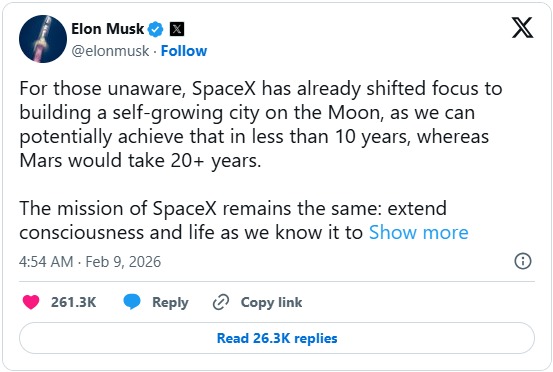
The Velocity of Capital Musk’s reversal on Mars is driven by the unyielding math of iteration. "For those unaware, SpaceX has already shifted focus to building a self-growing city on the Moon," Musk wrote on X. The logic? A launch window to Mars opens only once every 26 months. The Moon is accessible every 10 days.
In the high-cash-burn world of Silicon Valley hardware, waiting two years to test a hypothesis is a death sentence. By targeting a 2-day trip to the Moon, SpaceX can iterate its heavy industry and satellite deployment loop 78 times faster than a Mars-centric model would allow.
The "Gold" is Data, Not Dust Investors should remain skeptical of "lunar mining" pure-plays. The immediate value proposition described in recent reports involves using lunar factories to manufacture AI satellites and launch them via electromagnetic mass drivers. This creates a vertical integration monopoly: SpaceX builds the transport, the factory, and the power source for xAI's intelligence network, effectively locking out competitors like Blue Origin from the next generation of compute infrastructure.
Mars is still the dream, but the Moon is where the Q4 earnings will come from.


