Kawasaki will sell its rideable robot horse by 2035.
Kawasaki officially moves its viral "Corleo" robot horse into production. The hydrogen-powered biped is set for a 2035 release, backed by a new dedicated business division.

Image Credits: Kawasaki
The viral internet sensation "Corleo" is graduating from concept art to the assembly line, driven by 1 billion social media views and a new corporate division.
Kawasaki Heavy Industries just proved that in 2026, virality is a valid R&D metric. After its "Corleo" robot horse concept generated over 1 billion social media impressions following its Expo 2025 debut, the Japanese industrial giant has scrapped its "concept only" stance. The company confirmed this week it is establishing a dedicated business unit to put the machine into mass production, aiming to commercialize a heavy-duty, ridable robot biped for the open market.
This is not a toy; it is a massive industrial pivot. Kawasaki has formally established the SAFE ADVENTURE Business Development Team, a dedicated internal organization reporting directly to the presidency. The move signals that Kawasaki is looking for revenue streams beyond traditional motorcycles and heavy equipment, leveraging its robotics IP to crack the nascent "luxury mobility" market. The company is doubling down on Japan’s hydrogen infrastructure bet, positioning the machine not just as a robot, but as the future of clean, all-terrain transport.
The Corleo, originally unveiled in April 2025 as a "2050 vision" is being fast-tracked significantly. The new timeline targets a functional deployment at the Expo 2030 Riyadh, with full commercial sales scheduled for 2035. Unlike the battery-electric dominance seen in the auto sector, Kawasaki is utilizing a 150cc hydrogen engine that functions as an onboard generator, feeding electricity to four independent robotic legs. This hybrid powertrain addresses the "range anxiety" that plagues electric quadrupeds like Boston Dynamics’ Spot. By using hydrogen density, Kawasaki aims to facilitate long-range mountain traversal without the weight penalty of massive lithium-ion packs.
Kawasaki knows 2035 is a lifetime away for investors, so they are executing a clever digital-first strategy to bridge the revenue gap. The company plans to release a high-fidelity "Corleo Riding Simulator" by 2027, licensing the motion data and physics models to the gaming and e-sports industries. This allows Kawasaki to monetize the R&D immediately while crowdsourcing movement data from millions of gamers to train the robot's stabilization AI, effectively building brand loyalty a decade before the physical product ships.
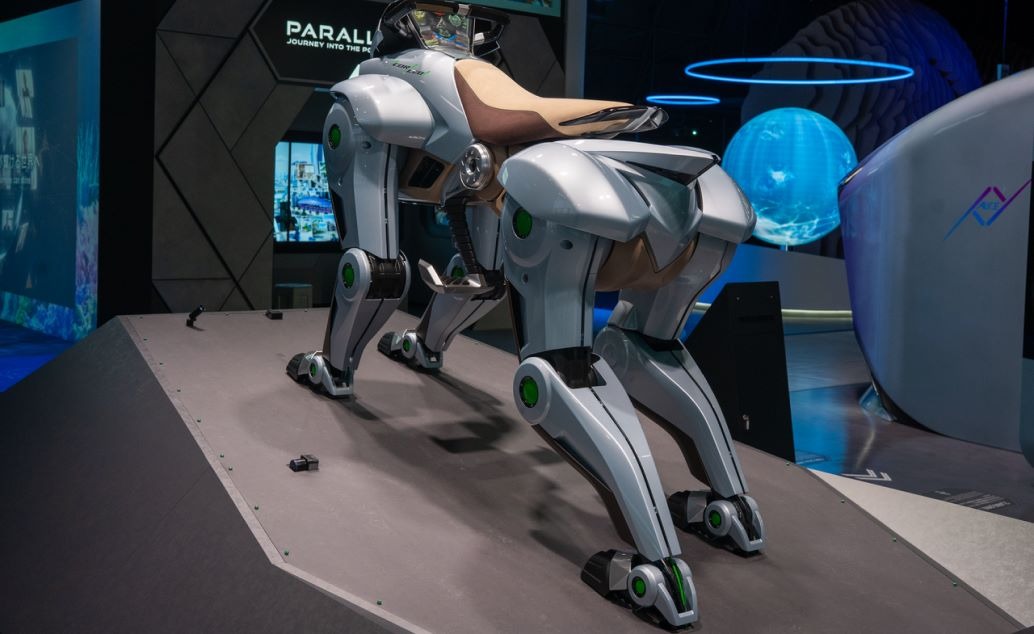
The business viability of the Corleo rests on its user interface, which completely abandons the steering wheel. Instead, it utilizes a proprietary "organic" control scheme where the rider steers by shifting their center of gravity, detected by pressure sensors in the stirrups and handlebars. While the marketing copy whimsically invites riders to unleash their "Impulse to Move," the engineering is severe. The rear legs utilize a modified motorcycle swing-arm mechanism to absorb shock independently, a direct technology transfer from their Ninja sportbike line that promises stability on terrain that would wreck a standard ATV.
Kawasaki is taking a massive reputational risk. If the Corleo ends up as vaporware, it will be an expensive embarrassment. But if the SAFE ADVENTURE unit succeeds, they will have effectively created a new vehicle category, the "all-terrain luxury biped, and cornered the market before Honda or Yamaha can even saddle up.


