OpenAI secures classified Pentagon military contract hours after Trump banishes rival Anthropic
Hours after the Trump administration blacklisted rival Anthropic, OpenAI swooped in to secure a classified Pentagon contract and lock down the defense market.
.jpg%3Falt%3Dmedia%26token%3D4d57819e-fa11-4fc3-97d7-b3746292fd7c&w=3840&q=75)
- OpenAI successfully secured a classified Pentagon contract just hours after its primary competitor was blacklisted.
- The artificial intelligence giant paired the government deal with a staggering new investment from Amazon to bolster cloud deployments.
- Sam Altman agreed to broad military use but implemented architectural limits to prevent autonomous weapons integration.
OpenAI just executed one of the most ruthless and lucrative pivots in the history of the artificial intelligence sector. Capitalizing on a Washington power vacuum, the company secured a massive classified military deal on the exact same day it locked down a staggering $50 billion investment from Amazon. The timeline is as brutal as it is profitable. Just hours after the Trump administration initiated a federal agency purge against its primary competitor, OpenAI swooped in to absorb the abandoned market share. For the broader tech industry, the message is chillingly clear: corporate ethics are negotiable, and the spoils of war go to the fastest dealmaker in Silicon Valley.
The drama unfolded at breakneck speed on Friday evening. After months of tension over military use of artificial intelligence, Anthropic CEO Dario Amodei refused to grant the government unrestricted access to his company's models. He cited strict prohibitions against domestic mass surveillance and fully autonomous weapons, a stance he publicly defended as fundamentally patriotic in a high-stakes television interview. In retaliation, the Pentagon immediately ripped up Anthropic's $200 million defense contract and labeled the American startup a national security supply chain risk.
But the government didn't stay empty-handed for long. Before the dust could even settle on Anthropic's exile, OpenAI CEO Sam Altman took to X to announce that his company had already signed a replacement deal. "Tonight, we reached an agreement with the Department of War to deploy our models in their classified network," Altman wrote.
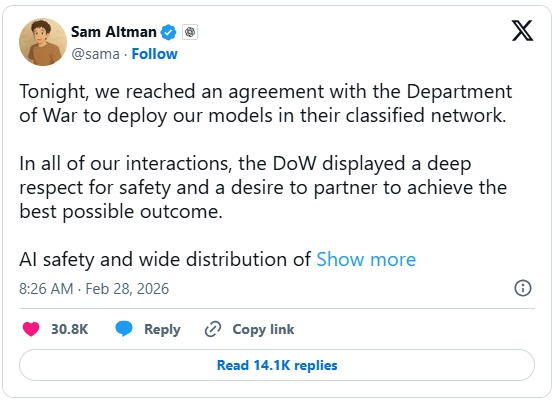
The ultimate irony of the situation lies in the fine print of OpenAI's new partnership. Altman explicitly claimed that his agreement includes the very same ethical guardrails that Anthropic was just destroyed for demanding. According to OpenAI, the Pentagon fully agreed to reflect prohibitions on domestic surveillance and autonomous lethal force in their new contract. The core difference appears to be architectural rather than ideological. While Anthropic demanded strict contractual language barring specific use cases, OpenAI agreed to the government's broad "all lawful uses" framework but negotiated the right to bake technical safeguards directly into its models. OpenAI will reportedly keep its systems confined to secure cloud environments, making edge deployments for autonomous drone strikes technically impossible.
From a business perspective, OpenAI is walking away as the undisputed victor of a chaotic week. The company's massive new funding round with Amazon is not just a capital injection; it is a tactical military advantage. Because the Pentagon heavily relies on Amazon's cloud infrastructure to run its classified networks, OpenAI now has the perfect technical pipeline to deeply integrate ChatGPT into the military apparatus.
The sheer whiplash of OpenAI's announcement has fractured Silicon Valley. Behind the scenes, hundreds of employees from both Google and OpenAI had previously signed open letters pledging solidarity with Anthropic's moral stance. Yet, the rapid deployment of this new defense contract proves that executive leadership is entirely willing to bypass employee sentiment when a lucrative government monopoly is on the table. The speed of the transaction suggests that Altman and his team were quietly negotiating their own classified integration while their rival was taking the public heat.
This maneuver fundamentally alters the enterprise software landscape. Companies doing business with the Department of Defense are now strongly incentivized to strip out Anthropic's Claude infrastructure and rapidly migrate their tech stacks to OpenAI to avoid running afoul of the new supply chain risk designation. The entire commercial sector is watching a live demonstration of how regulatory capture and political maneuvering can obliterate a competitor overnight. In the race for global AI dominance, holding the moral high ground might win you public sympathy, but playing the political game wins you the defense budget.


