OpenAI previewed GPT-5.6 Sol to the US government before showing it to anyone else
OpenAI's GPT-5.6 Sol launches in limited preview to roughly 20 organizations, after the company briefed the US government on its capabilities first.

OpenAI's GPT-5.6 series, led by the flagship Sol model, entered limited preview after the company shared its capabilities with the US government ahead of public launch.
- Government review came before launch – OpenAI briefed the US government on GPT-5.6 Sol's capabilities ahead of today's public announcement.
- A new "ultra" mode uses subagents – Sol can now split complex tasks across multiple coordinated agents instead of reasoning through them alone.
- A new "ultra" mode uses subagents – Sol can now split complex tasks across multiple coordinated agents instead of reasoning through them alone.
OpenAI is rolling out its most capable model yet to roughly 20 organizations worldwide, and the company briefed the US government on its capabilities before announcing it publicly. GPT-5.6 Sol, alongside two smaller siblings named Terra and Luna, launches today in a limited preview, with general availability promised only "in the coming weeks."
The model suite splits into three clear tiers. Sol is the flagship, built for the heaviest coding, cybersecurity, and biology workloads. Terra targets everyday work at lower cost. Luna is the cheapest tier, designed for high-volume, low-complexity tasks. OpenAI says GPT-5.6 Sol sets a new state of the art on Terminal-Bench 2.1, the benchmark measuring command-line workflows that require planning, iteration, and coordinating multiple tools, exactly the kind of long-horizon agentic task that separates a chatbot from something that can actually run a multi-step engineering job unsupervised.
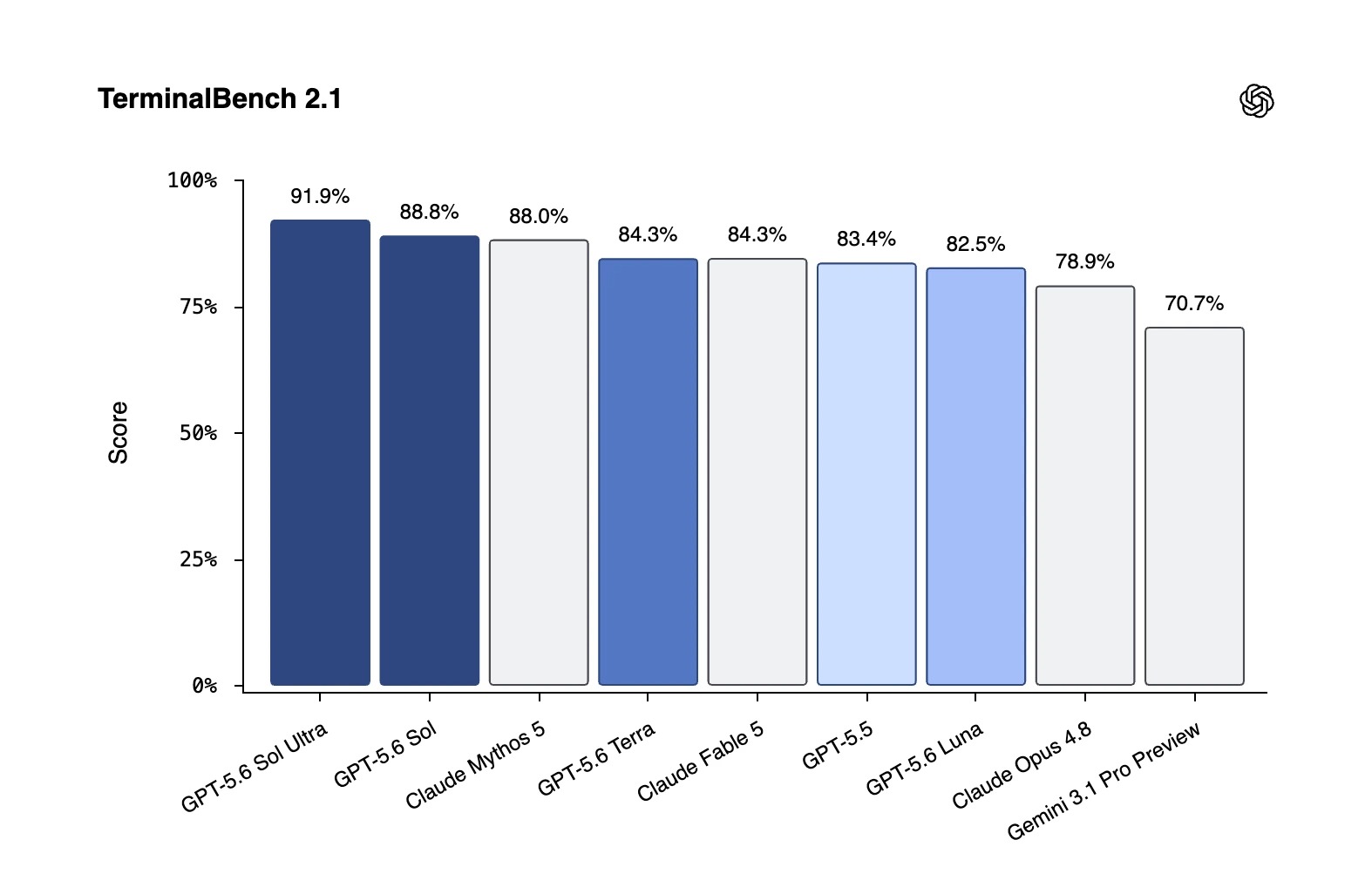
Terminal-Bench 2.1 scores: GPT-5.6 Sol vs GPT-5.5 vs prior models
What's new isn't just the score, it's how Sol gets there. The release introduces a "max" reasoning effort mode that gives Sol more time to think, and a separate "ultra" mode that goes beyond a single agent by deploying subagents to accelerate complex work. That second mode is the more significant shift: instead of one model reasoning step by step, ultra mode splits a task across multiple coordinated agents working in parallel, then combines what they produce. OpenAI's own announcement thread on X frames this as a structural change in how the model handles complex work, not just a speed boost.
The cybersecurity framing is deliberate and unusually candid for a model launch. OpenAI states that GPT-5.6 Sol identified bugs and exploitation primitives when tested against the Chromium and Firefox codebases, but did not autonomously produce a functional, full-chain exploit under the conditions tested keeping it below the company's self-defined "Cyber Critical" threshold. The company is explicit that this is a moving line: as the model's capabilities increase, so does the engineering effort going into safeguards designed to hold up against real-world adversarial pressure while still preserving legitimate uses like vulnerability research, patch development, and defensive testing.
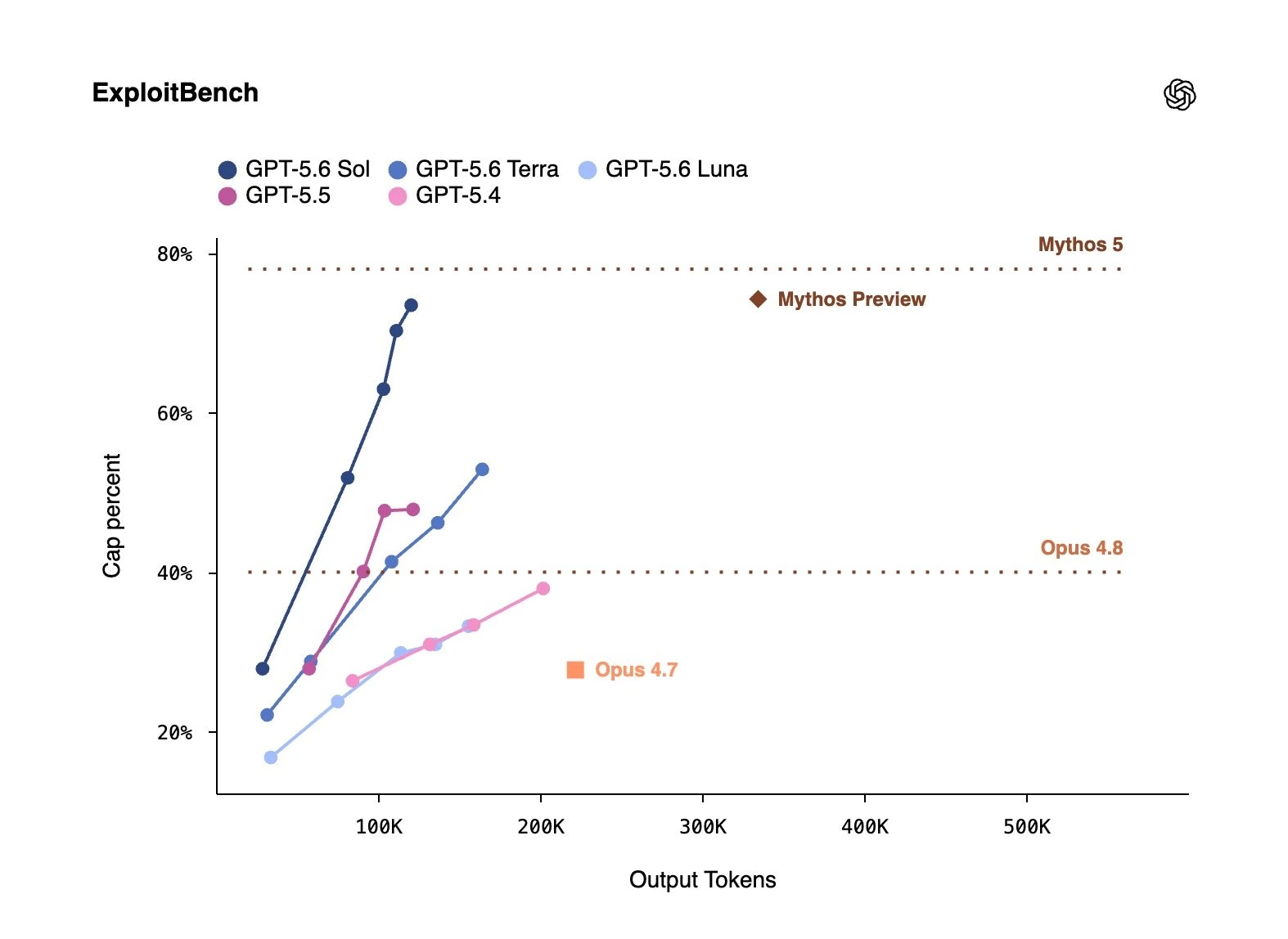
That tension between capability and access is the real story behind the staggered rollout. OpenAI states it previewed its plans and the model's capabilities to the US government ahead of today's launch, and that at the government's request, it is starting with a limited preview for a small group of trusted partners whose participation has been shared with the government, before expanding access more broadly. What this means in practice: for the first time, a frontier US AI lab is treating a model release the way a defense contractor might treat a new weapons platform, briefing regulators on capability before customers see it, rather than the more typical pattern of shipping first and answering policy questions after the fact.
This isn't happening in isolation. OpenAI's custom Jalapeño chip, built with Broadcom, was unveiled just two days before this announcement, aimed specifically at cutting the cost of running inference-heavy models like this one at scale. A government-vetted rollout for the most capable model OpenAI has built, arriving days after a custom chip built to run that exact kind of model more cheaply, suggests the infrastructure and the policy strategy are being built in step with each other, not as separate tracks.
The test ahead is simple to state and hard to predict: whether "the coming weeks" actually means weeks, or whether government review extends the preview period well past what OpenAI is currently signaling. If Sol reaches general availability on the timeline OpenAI is promising, this becomes a template other frontier labs may have to follow. If it doesn't, the gap between announcement and access becomes the story instead of the model itself.


