Jack Dorsey guts Block workforce to build an AI first fintech giant
Jack Dorsey slashes 40% of Block’s workforce in a ruthless pivot to AI-driven efficiency. As stock prices soar, the fintech giant signals a permanent shift in how tech companies are built and run.
.jpg%3Falt%3Dmedia%26token%3Dbb4bec81-daa9-400b-96e4-843861e610df&w=3840&q=75)
- Block eliminates 40 percent of its staff to prioritize AI-driven efficiency.
- Shares surged over 24 percent as investors cheered the aggressive restructuring and lower overhead.
- Internal automation has already increased engineering output, justifying the aggressive headcount reduction.
Jack Dorsey is taking a sledgehammer to the silicon structure of Block, eliminating 4,000 jobs in a ruthless pivot toward a leaner, intelligence-native future. The move, which slashes the company’s headcount from over 10,000 down to just under 6,000 employees, is a calculated bet that artificial intelligence can replace human overhead without sacrificing growth. In a high-stakes memo to shareholders on February 26, 2026, Dorsey framed the cuts not as a sign of distress, but as an absolute inevitability for the entire tech sector.
The financial markets immediately validated the carnage. Shares of Block surged over 24 percent in extended trading following the announcement, reflecting a ravenous investor appetite for AI-driven efficiency. By shedding nearly half its workforce, Block expects to incur roughly $450 million to $500 million in restructuring charges, a short-term penalty for a long-term recalibration. The brutal math of the AI era is taking hold: fewer people, fatter margins.
“Intelligence tools have changed what it means to build and run a company,” Dorsey told investors, noting that internal systems like the AI agent "Goose" are already saving engineers eight to ten hours a week. He argued that Block is merely a precursor to an industry-wide reckoning. “Within the next year, I believe the majority of companies will reach the same conclusion and make similar structural changes,” Dorsey stated. For Dorsey, the bloat of the pandemic-era hiring spree, where Block grew from 3,800 workers in 2019 to over 10,000, is being surgically removed by automation.
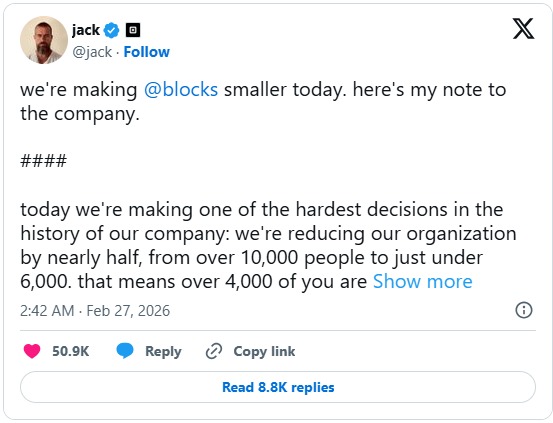
Crucially, this is not a story of a struggling legacy business. Block’s fundamentals remain robust. The company reported a 24 percent year-over-year increase in gross profit to $2.87 billion in its latest quarter, with Cash App continuing to drive immense revenue. Instead, this is a strategic liquidation of human capital. Dorsey is choosing to pay a heavy premium now, offering outgoing staff 20 weeks of base pay and a $5,000 transition stipend to avoid what he calls the morale-destroying process of repeated, incremental layoffs. “Repeated rounds of cuts are destructive to morale, to focus and to the trust that customers and shareholders place in our ability to lead,” he explained.
The implications for the broader tech ecosystem are chilling. If a fintech titan like Block can successfully operate massive platforms like Square and Cash App with half its staff, the "over-hired" defense used by CEOs will seamlessly transition into a permanent AI-optimized operating standard. Dorsey is signaling that the era of sprawling tech campuses is officially over, replaced by smaller teams orchestrating autonomous software.
While Wall Street cheers the sudden margin expansion, the human cost is stark and immediate. Reports emerged of employees being locked out of systems mid-task, with one data analyst receiving his termination notice while actively interviewing a new candidate. These 4,000 workers are now entering a job market that is increasingly hostile to white-collar talent, facing off against the exact same intelligent algorithms they helped to implement.
Yet, Dorsey remains completely unapologetic, viewing this not as a corporate tragedy but as a forced, necessary evolution. He argues that trying to integrate artificial intelligence while maintaining legacy headcounts is a recipe for stagnation. By acting aggressively now, he believes Block will emerge as a significantly faster, vastly more profitable machine. For the rest of Silicon Valley and the executives watching their own stock prices, the warning is unambiguous: the AI revolution is no longer just about shipping new product features; it is actively rewriting the payroll, and latecomers will be punished by the market.


